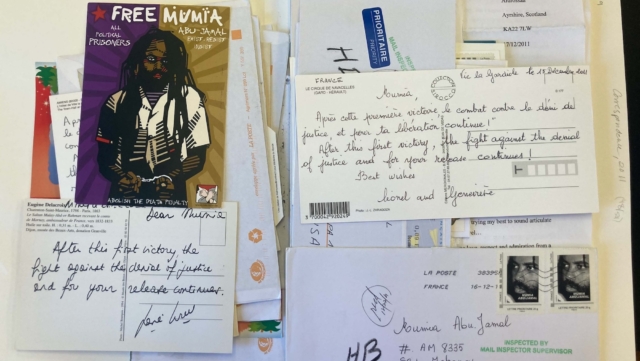
Letters of support received by Mumia Abu-Jamal after the overturning of his death sentence, 2011, Mumia Abu-Jamal papers, MS.2022.009, Brown University Library. Image credit: Anna Robinson-Sweet
Abolitionist Archival Imaginaries: The World-Building Praxis of Memory Work on Incarceration
Anna Robinson-Sweet, Information Studies, UCLA
Ideas and Organizing Doctoral Awardee 2025-26
“Abolitionist Archival Imaginaries” is an ethnographic study of three archives that collect materials from those who have experienced incarceration: After Violence Project (AVP), a community archive that documents the impact of state violence; Rikers Public Memory Project (RPMP), a community oral history project dedicated to the closure of New York City’s Rikers Island jail complex; and the Voices of Mass Incarceration (VMI) initiative at Brown University, which stewards manuscript collections from those affected by the prison system. In the U.S., around two million people are currently incarcerated, nearly half of the population has a family member who is or has been in prison, and the lifetime probability of incarceration for men is almost ten percent. Despite prison’s prevalence in American life, archives have mostly failed to document lived experiences of incarceration, leaving us with an archival record that heavily favors the state’s perspective. These records are used to construct narratives that criminalize individuals and communities, particularly Black, Indigenous, and other people of color. At the same time, however, survivors of state violence, organizers, and advocates are increasingly using memory work as a tactic for denaturalizing the prison’s place in our society.
“Abolitionist Archival Imaginaries” studies this memory work, asking if and how it helps us imagine and move toward futures free from the violence of imprisonment. This question in explored through community-engaged research at AVP, RPMP, and VMI. Through in-depth interviews with archives staff and formerly incarcerated contributors, observation of events at the sites, and study of their collections, this study identifies the significance of memory work at four levels: personal, practical, political, and epistemological. Seen through the lens of abolition feminism, these levels of significance represent interconnected areas of struggle in ending incarceration. This is the abolitionist archival imaginary: the use of archives to imagine and enact a post-carceral future.