
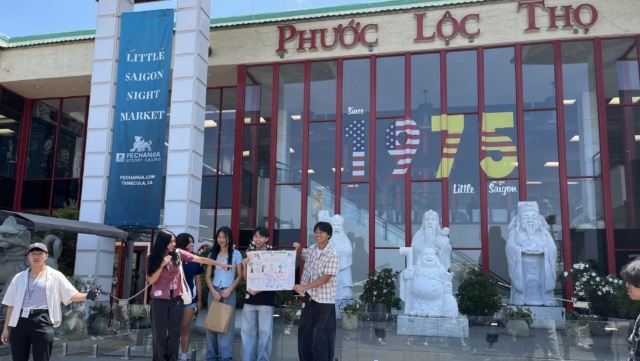
Local high school students participating in a VietRISE activity at Phước Lộc Thọ in Westminster, Little Saigon, California. Image credit: Emma Tran
American Dreaming After 1975: Challenges and Opportunities for Progressive Organizing in the Politically Contested Landscape of Little Saigon
Emma Tran, Community Health Sciences, UCLA
Ideas and Organizing Doctoral Awardee 2025-26
While the emergence of right-wing politics among racialized people in the US has taken many in academia and others by surprise (resulting in myopic narratives that pathologize or dismiss such beliefs), its longer history in Little Saigon, Orange County, reveals how conservatism might be thought of as an emergent strategy against dispossession and exclusion from American life. Though Vietnamese American conservatism cannot be reduced to anti-communism, it is usually traced to anti-communism following the victory of the National Liberation Front of South Vietnam in 1975, which subjected millions to refugeehood. In turn, Vietnamese American anti-communism is thought to fundamentally structure Little Saigon culturally and politically, and its semiotic domination here (in frequent co-occurrence with symbols of white nationalism) makes ideological pluralism seem implausible. Still, perhaps given its affordances for many dimensions of Vietnamese American self-determination in Southern California, anti-communism is regarded as an inevitability, as a naturalized outcome of trauma, rather than one articulation of many possibilities.
The challenges therein of this political landscape are brought into sharp relief for local community organizers such as VietRISE, who mobilize progressive agendas on behalf of working-class Little Saigon residents, such as the historic rent stabilization ordinance passed in Santa Ana in 2021. While community organizers are often opposed by people in power who are invested in status quo arrangements, VietRISE faces the additional challenges of facing critique from within the Vietnamese American community, who often accuse its organizers of being Americanized, brainwashed, or communist sympathizers in gendered, adultist, and classed ways. To clarify the extent to which these political dynamics map onto other intergenerational relationships in Little Saigon, this research project collaborates with VietRISE to ask: how do young women growing up here make sense of the political context? What opportunities arise for their political activation? Finally, what are their American dreams? This project takes an ethnographic approach and has thus far collected three years of ethnographic fieldwork, as well as 57 person-centered ethnographic interviews with Vietnamese American women and nonbinary young adults, high school teachers, and community organizers.
Initial findings reveal that anti-communism, and the right-wing politics that it often registers, are perceived by young women as overwhelmingly pervasive, and that they are socialized through the site of the militarized family; through educational institutions such as Vietnamese language programs; and through the normalization of its visual, sonic, historiographical, and even culinary representations across all of Little Saigon. Moreover, the rendering of anti-communist politics as an inevitability of trauma is reinforced by the repression of young people from claims to cultural authenticity if they attempt to articulate a different kind of politics. Organizing with political peers, therefore, presents opportunities not only where Vietnamese youth can find community and coalition, but also where they can configure more self-determinant versions of “being Vietnamese” that subvert conservative expectations. As such, the work of organizers such as VietRISE is critical, as it provides safety and belonging for young Vietnamese Americans who are eager to forge a sort of ethnocultural identity premised on solidarity, freedom, and self-determination.